Every promotion round has one name that nobody argues about: the top salesperson, the officer who never misses a deadline, the branch's go-to person when something breaks. Promoting them feels like the safest call in the room. Very often it is the riskiest one. This article is for HR heads and CEOs who want to check whether someone is ready to lead before the title is announced, not six months after.
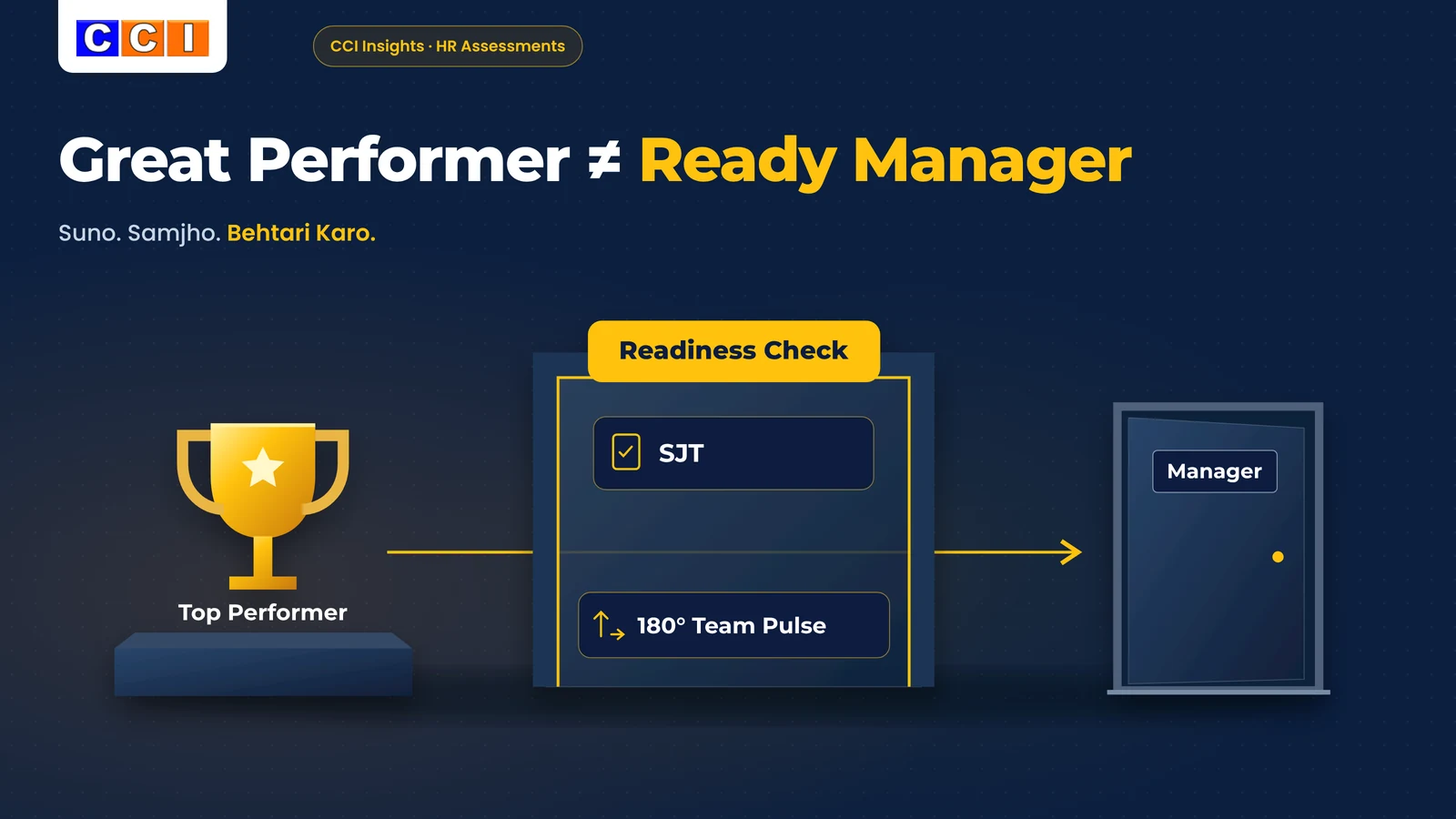
Great Performer ≠ Ready Manager
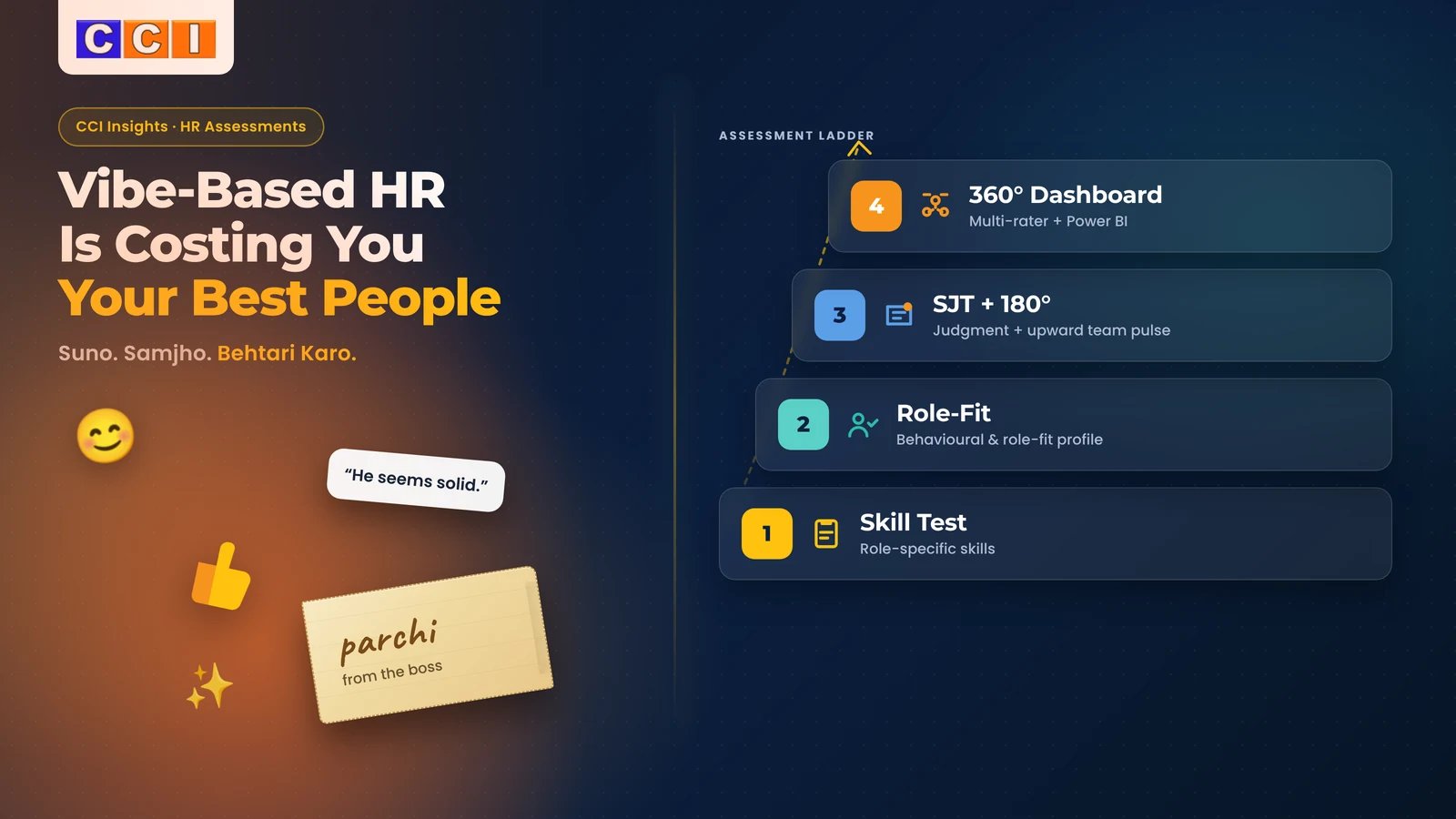
In our earlier piece on vibe-based HR, we looked at how gut feel shapes hiring, appraisals and promotions across a company. This article goes deeper into one decision: moving an individual contributor into their first people-management role.
The trap is simple. We promote people for what they did in their old job and then judge them on a completely different one. A star salesperson is rewarded for personal targets, speed and independence. A supervisor is rewarded for other people's targets, patience and letting go. The habits that made someone excellent can work against them once they are responsible for a team:
- They do the work themselves. When a team member is slow, the new supervisor takes over the file or the client call. The numbers survive for a while; the team never learns.
- They manage by example only. “Watch how I do it” is not coaching. People who were naturally good at the job often struggle to explain why what they do works.
- They avoid the hard conversation. Correcting a former colleague, especially an older one, is uncomfortable. In a seniority-conscious workplace, many new supervisors simply stay quiet and let standards slide.
- They play favourites without meaning to. Old friends from the team get the easier territory or the benefit of the doubt, and everyone else notices.
None of this means the person was a bad choice. It means nobody checked for the skills the new role needs.
Why Pakistani Workplaces Promote This Way
Promotion by performance and tenure is deeply built into how many organisations here work. There are good reasons for it, and some less helpful ones.
Seniority culture and the “turn” system
In many companies, the next supervisor slot is quietly understood to belong to whoever has waited longest or delivered most. Skipping that person can feel disrespectful, so the promotion becomes a reward for loyalty rather than a decision about leadership.
Promotion as the only way to recognise talent
If the only route to a better salary and title is managing people, your best specialists will take it, whether or not they want to lead. Without a respected senior specialist track, you force a choice between losing them and miscasting them.
The parchi and the persuasive boss
Sometimes the recommendation carries more weight than the evidence. A strong word from a senior leader can settle a promotion before anyone has looked at how the candidate handles people.
The Real Cost: Two Losses From One Decision
A wrong promotion rarely fails loudly. It fails quietly, in two places at once.
You lose the performer
The person who used to carry the numbers is now in meetings, chasing reports and handling complaints. Their own output drops, and many feel the drop more than anyone. Some cope by working longer hours; some lose confidence; some start looking outside, where a company will hire them back into the work they loved.
The team's high performers check out
The bigger cost sits below them. Strong team members can tell quickly when their new supervisor cannot coach, decide fairly or shield them from chaos. They don't complain to HR. They stop offering ideas, do exactly what is asked, and wait for a better offer. By the time it shows up as attrition, the damage was done months earlier, and the exit interview will politely say “better opportunity”.
What Promotion Readiness Actually Means
Before you can test readiness, you need to agree on what it is. For a first-time supervisor or branch lead, it usually comes down to a handful of behaviours:
- Delegating instead of doing it all personally
- Coaching a struggling team member rather than replacing their effort
- Handling conflict between team members, or with a former peer
- Prioritising under pressure when targets, customers and head office all want something at once
- Fairness: making decisions the team can see were not about friendship
- Escalating sensibly, knowing what to solve and what to take upstairs
You will notice none of these show up in a sales leaderboard. That is the point.
A 5-Step Promotion-Readiness Check
This is a practical process HR can run without slowing the promotion calendar. Durations are indicative and depend on the role.
- Separate the reward from the role. Recognise strong performance with pay, recognition or a senior specialist title. Treat the people-management promotion as a separate decision with its own criteria.
- Define “ready” for this specific role. Sit with the line managers who will rely on the new supervisor and agree which of the behaviours above matter most, for example conflict handling for a branch lead or prioritising for a distribution supervisor.
- Run a Situational Judgment Test before the decision. A short SJT, typically around 15–20 minutes, puts shortlisted candidates in realistic scenarios: a team member missing targets for the third month, two staff in open conflict, an escalation from an important customer. It shows how they would think as a manager, not how well they sell themselves in an interview. Every candidate faces the same scenarios, whoever recommended them.
- Use the results to decide and to develop. Review SJT results alongside performance and manager input. Where someone is close but not ready, give them a clear development plan through targeted training instead of a silent “not this time”.
- Check in after 90 days with a 180° upward pulse. Once the new supervisor is in the seat, their direct reports answer a short set of around 5–8 questions about how they are being led, and the supervisor completes the same questions as a self-rating. The gap between the two shows where coaching is needed early. It is upward feedback from the team, not a peer review, and it is far lighter than a full 360°.
What about senior roles?
For HoDs and senior management, promotion and succession decisions deserve a fuller view. Confidential 360° leadership feedback, presented on live Power BI dashboards, compares a leader's self-view with input from their manager, peers and reports. That depth makes sense at the top; for first-time supervisors, the SJT and 180° pulse give you the essentials at a fraction of the effort.
Making It Stick
A readiness check only works if managers trust it. Three habits help:
- Be transparent with candidates. Tell people what readiness means and how it will be assessed. Most high performers respect a clear bar more than a quiet decision.
- Don't let the test become another formality. If results are ignored whenever a senior leader has a favourite, the process loses credibility fast.
- Close the loop. Every assessment should lead somewhere: a promotion, a development plan or a coaching conversation. A score with no follow-up is just more paperwork.
Frequently Asked Questions
Why do top performers sometimes fail as managers?
Because managing people uses different skills from doing the job well. Delegating, coaching, handling conflict and making fair decisions are not proven by strong individual results, so they need to be checked separately.
What is a promotion-readiness assessment?
It is a structured way to check whether someone can handle a people-management role before they are promoted. For first-time supervisors, CCI uses a Situational Judgment Test plus a 180° upward pulse after the move.
How long does an SJT for supervisors take?
Typically around 15–20 minutes, depending on the role. It fits easily into a normal promotion cycle.
What is the difference between a 180° upward pulse and a 360°?
A 180° upward pulse is a short set of around 5–8 questions answered by a supervisor's own team and compared with their self-rating. A 360° adds managers and peers, takes more coordination and suits HoDs and senior leaders.
What if our best performer is not ready to manage?
Give them a development plan with targeted training and a clear path to reassessment, and consider recognising them through pay or a senior specialist role so you keep their expertise.
Promote on Evidence, Not Just on Results
Your best performers deserve a promotion process that sets them up to succeed. Explore CCI's employee assessments, SJTs and 360° feedback, see how we turn readiness gaps into targeted training, or request a proposal for your next promotion round.
Suno. Samjho. Behtari Karo.