Most Pakistani companies would never call their people decisions "vibe-based". Yet across banks, FMCG distributors, retail chains and service businesses, hiring, appraisals and promotions still run, more often than leaders admit, on gut feel. This article is for HR leaders and CEOs who suspect the same is happening in their own company.
What Vibe-Based HR Actually Looks Like
Ask any HR head in Karachi, Lahore or Islamabad whether their company hires and promotes on merit, and the answer will be yes. Then look at how the decisions are actually made.
Vibe-based HR is rarely a policy. It is a set of habits that build up quietly because they are fast and feel reasonable at the time:
- Appraisals that run on rapport. The employee who sits near the manager, laughs at the right jokes and is visible on WhatsApp after hours gets the stronger rating. The quiet one who closes the books on time every month gets “meets expectations”.
- Recency bias. A year of steady work is judged on the last six weeks. One strong December presentation outweighs eleven months of reliability, or one bad week erases them.
- The ‘parchi’ in hiring. A referral from a director, a client or a family friend moves a CV to the top of the pile, and the interview becomes a formality. Referrals are not wrong in themselves, but without a common bar every candidate has to clear, they become a shortcut around judgment.
- Interviews that test confidence, not competence. A twenty-minute panel chat rewards fluent English and a firm handshake. It tells you very little about whether someone can reconcile a ledger, handle a branch compliance query or close a difficult sale.
None of this comes from bad intent. It comes from managers being asked to make people decisions without any structured evidence to make them with.
Why 360° Feedback Can't Fix This at Every Level
The usual answer to “our appraisals are subjective” is “let's run a 360”. For senior leaders, that is the right instinct. A properly run 360-degree leadership feedback programme gathers confidential input from a leader's manager, peers and direct reports, and exposes blind spots that no single rater can see.
But a full 360° is lengthy. It needs several raters per person, careful coordination and time from everyone involved. That is why, in Pakistan, organisations sensibly reserve it for HoDs and senior management.
The problem is what happens below that line. Officers, frontline sales and operations staff, and first-time supervisors make up most of the workforce, and their hiring, confirmation and promotion decisions are still left to guesswork. The heaviest tool sits at the top, and the most decisions happen where there is no tool at all.
The Tiered Fix: The Right Assessment for Each Level
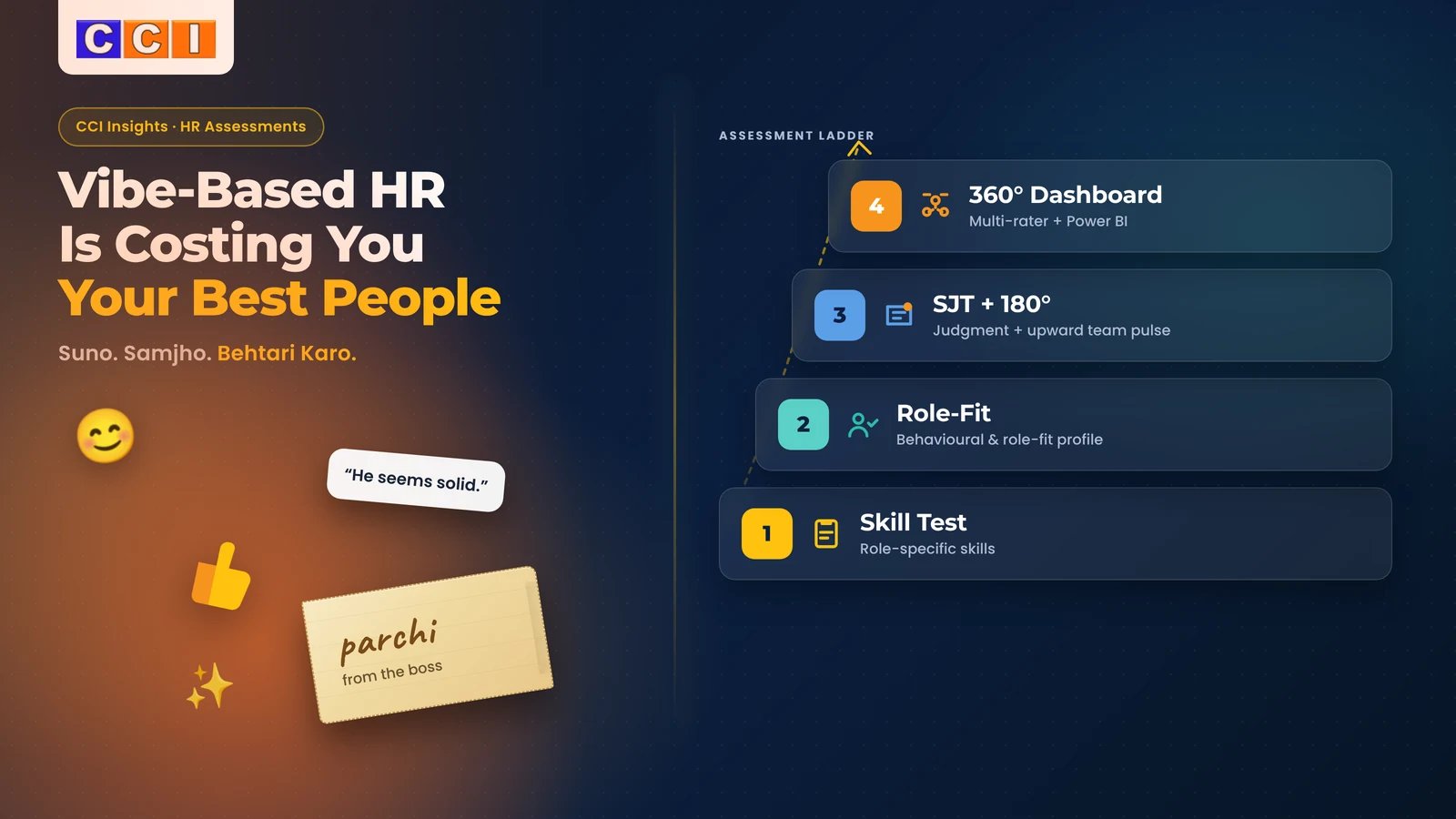
The answer is not one assessment for everyone. It is a short, practical check matched to each tier, light enough that it doesn't slow down operations. Durations below are indicative and depend on the role.
| Level | Decision it supports | Assessment | Typical length |
|---|---|---|---|
| Officers, executives & support staff | Hiring and confirmation | Role-specific skill & technical assessment (e.g. Excel and data accuracy, banking operations and compliance, business communication) | Around 20–30 minutes |
| Frontline sales & operations | Hiring and placement | Behavioral & role-fit profiling: matching natural working style to the reality of the job | Typically around 15 minutes |
| First-time supervisors & branch leads | Promotion and first 90 days | Situational Judgment Test (SJT) before promotion, plus a 5–8 question 180° upward manager pulse | Around 15–20 minutes for the SJT |
| HoDs & senior management | Development and succession | Confidential 360° leadership feedback on live Power BI dashboards | Full multi-rater cycle |
Officers, executives and support staff: test the skill, not the CV
A short, role-specific test shows whether someone can actually do the work, whether that means cleaning a data set, applying a compliance rule or drafting a clear client email. It gives the hiring manager a scorecard instead of an impression, and it treats the candidate with a parchi and the one without one exactly the same.
Frontline sales and operations: check the fit
A high-energy closer and a detail-driven operations specialist are both valuable, but in the wrong seat each will struggle. Brief behavioral and role-fit profiling helps place people where their natural style matches the job, before a confirmation decision is made.
First-time supervisors and branch leads: test readiness before the title
A Situational Judgment Test puts candidates in realistic scenarios such as an underperforming team member, a branch escalation or a missed monthly target, and asks how they would respond. It tests people-management instinct before the promotion, not after. In the first 90 days, a short 180° upward pulse from direct reports, paired with the supervisor's own self-rating, flags who needs coaching early, without the heavy coordination of a full 360°.
HoDs and senior management: the full 360°
At the top, a single leadership blind spot can shape culture across an entire department. Confidential 360° feedback, mapped onto live Power BI dashboards, compares self-ratings with input from managers, peers and reports across goal clarity, coaching, fairness and collaboration. It gives CHROs and CEOs an objective basis for executive coaching and succession planning.
How to Start: A 4-Step Rollout for HR Teams
- Pick the decision that hurts most. Don't assess everyone at once. Start where gut-feel calls cost you the most: the next supervisor promotion round, a frontline hiring drive, or the annual HoD review.
- Define what ‘good’ looks like for that role. Agree the skills, behaviors and scenarios that matter with the line managers who will use the results. If managers don't trust the yardstick, they will go back to vibes.
- Pilot with one cohort. Run the assessment for one department or region, compare the results with how managers would have decided anyway, and look closely at where they disagree. Those gaps are the insight.
- Make it routine and close the loop. Build the assessment into the hiring, confirmation or promotion workflow, and link the gaps it surfaces to targeted training and development so that assessment leads to growth, not just a score.
Frequently Asked Questions
What is vibe-based HR?
Vibe-based HR means making hiring, appraisal and promotion decisions on gut feel, personal rapport, referrals or recent impressions rather than structured evidence of skill and readiness.
Should every employee get a 360-degree review?
Usually not. A full 360° is lengthy and works best for HoDs and senior management. Other levels are better served by shorter role-specific skill tests, role-fit profiling, or SJTs with a 180° upward pulse.
What is a Situational Judgment Test (SJT)?
An SJT presents realistic workplace scenarios and asks how the candidate would respond. It is widely used to check people-management readiness before someone is promoted to supervisor or branch lead.
What is a 180° upward manager pulse?
It is a short set of around 5–8 questions answered by a new supervisor's direct reports, compared with the supervisor's self-rating. It flags coaching needs early without the coordination a full 360° requires.
How long do pre-employment skills assessments take?
Role-specific skill and technical assessments typically take around 20–30 minutes, and behavioral role-fit profiling around 15 minutes, so they fit into a normal hiring process.
Replace Guesswork with Evidence, One Level at a Time
Vibe-based decisions feel fast until you count what they cost. Explore CCI's employee assessments and 360° feedback, see how we turn gaps into targeted training, or request a proposal for your next hiring or promotion round.
Suno. Samjho. Behtari Karo.