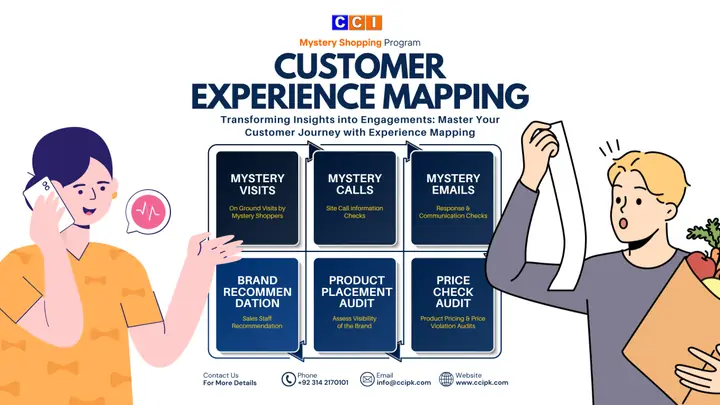
What Is Customer Experience (CX) Mapping—and Why Does It Matter?
In today's competitive Pakistani marketplace—whether in retail banking, healthcare diagnostics, telecommunications, hospitality, automotive dealerships, or modern retail—competing on price alone is a race to the bottom. Products and pricing can be replicated within weeks, but a seamless, empathetic, and reliable Customer Experience (CX) is extraordinarily difficult for competitors to copy.
Customer Experience Mapping is the structured process of documenting every interaction a customer has with your brand—from the first social media ad or Google search to walking into a branch, speaking with frontline staff, completing a transaction, and seeking post-sale support. Rather than viewing operations through internal departmental silos (Marketing, Operations, Sales, Customer Support), a CX Map forces leadership to experience the business through the eyes of the customer.
Mapping the End-to-End Customer Journey in Pakistan
When CCI partners with leading organizations across Pakistan to map and audit their customer journeys, we evaluate five interconnected stages where customer trust is either won or lost:
2.1 Stage 1: Awareness & Digital Discovery
Before a customer ever steps foot into your store, clinic, or bank branch, they check your Google Business Profile, location pin, website, or social media pages. Inaccurate branch hours, broken phone numbers, or slow-loading pages create friction before the relationship even begins.
2.2 Stage 2: Pre-Visit Inquiry (Helpline, WhatsApp & Chat)
Customers frequently call a helpline or message on WhatsApp to confirm pricing, product availability, or documentation requirements. Long hold times, unscripted responses, or conflicting information between the call center and the physical branch immediately erode confidence.
2.3 Stage 3: The Physical Branch or Store Touchpoint
This is the "Moment of Truth." Parking convenience, security guard courtesy, branch ambiance, queue waiting time, staff grooming, greeting warmth, and product knowledge determine how the customer feels during the interaction. Independent Mystery Shopping audits frequently reveal that while SOP manuals look great in head office, frontline execution varies dramatically between cities and shifts.
2.4 Stage 4: Billing, Checkout & Service Fulfillment
Speed, transparency, POS reliability, and clear explanation of next steps (delivery timelines, warranty terms, or lab report readiness) turn a first-time buyer into a confident advocate.
2.5 Stage 5: Post-Sale Support, Recovery & Retention
How your team handles a complaint, exchange, or delayed delivery defines long-term retention. Research consistently shows that customers whose complaints are resolved quickly and empathetically often become more loyal than customers who never experienced an issue at all.
Validating Your CX Map with Field Data
The biggest mistake organizations make with Customer Experience Mapping is treating it as a one-time boardroom workshop. Executives gather in a meeting room, draw how they assume branches operate, and file the presentation away.
To make a CX Map actionable, every touchpoint must be measured against real-world ground truth using three complementary tools:
- Walk-In, Video & Telephonic Mystery Shopping: Certified evaluators test your branches, dealerships, restaurants, and call centers using objective scorecards aligned to each stage of your CX map.
- Real-Time QR Code Customer Feedback: Table, counter, and receipt QR codes capture instant sentiment from real customers at the exact moment of service—triggering instant SMS/email alerts to branch managers when a low rating is submitted.
- Customer Satisfaction (CSAT & NPS) Research: Quantitative and qualitative market research uncovers the deeper emotional drivers behind customer churn and brand preference.
A Practical 5-Step CX Mapping Checklist for Leadership
- Define Your Core Customer Personas: Map separate journeys for walk-in retail shoppers, corporate/VIP clients, and digital-first customers.
- Inventory Every Touchpoint: List every physical, telephonic, and digital interaction—including "invisible" touchpoints like parking, security guards, and SMS notifications.
- Identify Pain Points & Emotional Highs/Lows: Pinpoint where queues build up, where staff lack product knowledge, and where customers abandon transactions.
- Set Measurable Standards (SOPs & SLAs): Define clear benchmarks (e.g., greeting within 30 seconds, helpline answer within 3 rings, complaint resolution within 24 hours).
- Audit, Train & Iterate Quarterly: Pair ongoing Mystery Shopping with targeted Corporate Training & SOP Coaching so frontline teams continuously improve.